“The history of mankind is carried on the back of a horse.” – Anonymous.
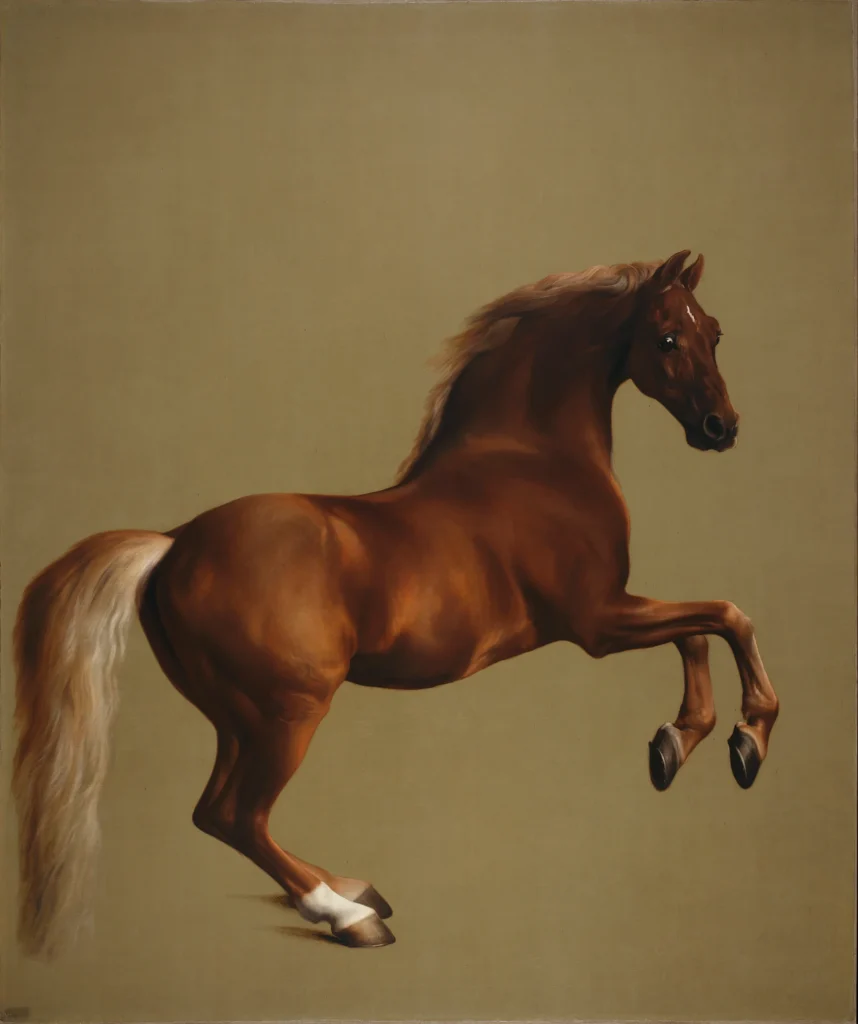
Whether it’s a duty entrusted to us by a higher power or an organic hierarchy hashed out over billions of years, we’ve made something of a habit of shirking our responsibility to the natural world. With each industrial bound we take, the framing of our destruction of nature as an unsavoury but ultimately acceptable matter of breakage detaches us further from our source; our telos. Horses, however, have maintained a special placement in the hierarchy; not level but certainly close by us. One might argue that it’s purely for utility’s sake – they’re great for war, labour and betting on. George Stubbs would point to something bigger and more mystical, with his forensic study of the anatomy leading him to produce perhaps the greatest painting of a horse ever – Whistlejacket (more on this later).
A new exhibition at the National Gallery shines a light on his lesser known stable mate, Scrub. Also featured is his spectacularly named treatise The Anatomy Of The Horse, (Including A particular Description of the Bones, Cartilages, Muscles, Fascias, Ligaments, Nerves, Arteries, Veins, and Glands. In Eighteen Tables, all done from Nature) (1766) along with Stubbs’ later works.
The son of a tanner, George Stubbs was raised around the slaughter of animals. The minutiae of flesh, skin, sinew – the smell of it all – was part of everyday life. Amongst the gore of his father’s trade, he was able to derive something soulful and began to paint animals. No doubt informed by his upbringing, he maintained a fascination with anatomy alongside his artistic pursuits. That fascination germinated into obsession and he exiled himself to a remote barn in Horkstow, where he would carry out meticulous dissections of horses for the purposes of his treatise.
For 18 months, he examined all layers of his equine subjects. He would peel back the flesh and fibres, recording every minute detail as he went. Posing the bodies as if the horse was still alive, he produced frontal, lateral and posterior views of each facet of the anatomy, from the skin and the musculature to the skeleton. You can see Stubbs chiselling away at it in all his documented studies; gradually getting closer to the horse, revealing not only its anatomical secrets but an innate essence of the animal. The most thorough study undertaken on the anatomy of horses for over a hundred years, it resulted in the greatest images of the subject ever recorded and provides an astounding ‘making-of’ for Scrub and Whistlejacket.
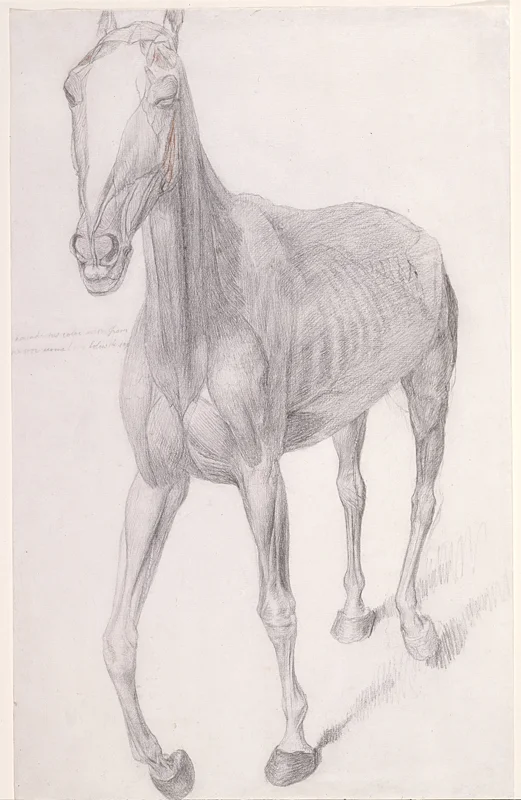
Working drawing for ‘The Seventh Anatomical Table of the Muscles, Fascias, Ligaments, Nerves, Arteries, Veins, Glands, and Cartilages of the Horse’, 1756-1758
© Royal Academy of Arts, London.
Stubbs was commissioned by the Marquis of Rockingham to paint a portrait of the newly crowned King George III – specifically his champion race horse in a supporting role to the king. When the Whistlejacket part of the painting was complete, however, it was deemed too perfect to sully with human presence. By the time Scrub was made to take its place, the Marquis had resigned his post as Lord of the Bedchamber and reneged on the commission.
This is the first time Scrub has been exhibited to the public and it is extraordinary. You can see the sheen travel across the chestnut flanks of the horse as the day goes on and the light changes. The velvet surface ripples with the powerful mechanisms working beneath; liquid muscle and unyielding framework. It really moves. The longer you look, the clearer Stubbs’ genius becomes. There are nuances that a simple painter couldn’t pick up on. They are sub-surface, proto-visual – unseen by those who haven’t truly inhabited the subject. Stubbs’ studies and subsequent illustrations are so precise that they’re still used by veterinary colleges today, but it’s his comprehension of the soul that elevates these paintings beyond the textbook.
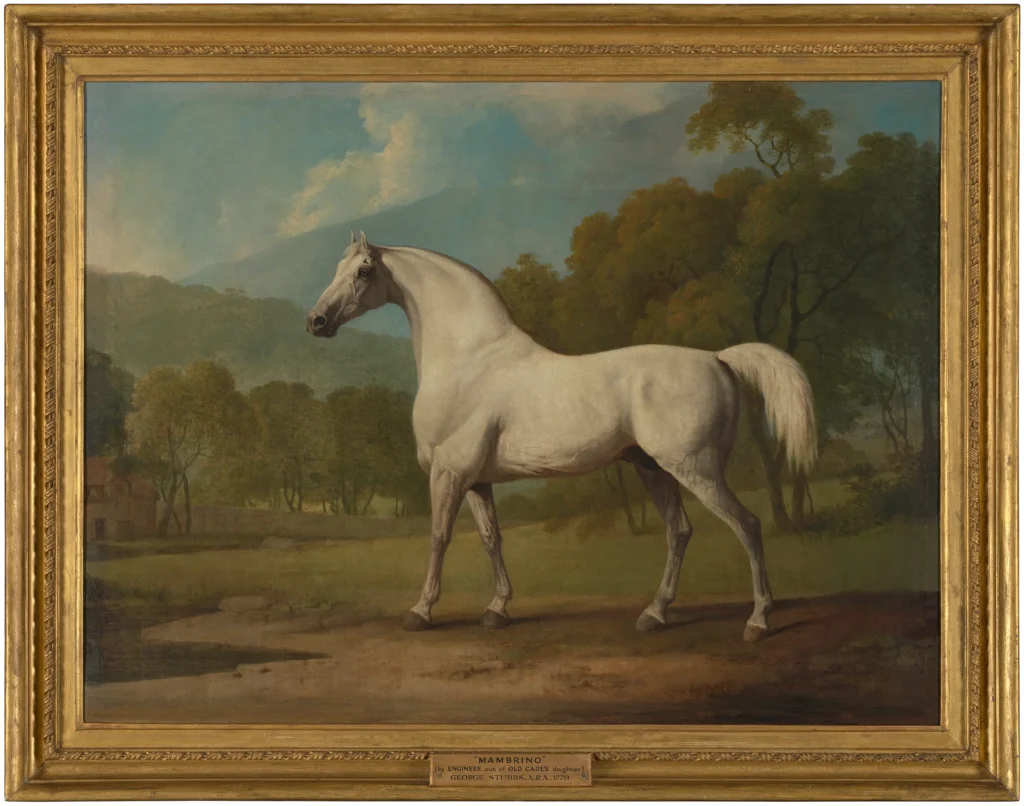
Mambrino, 1779
Oil on canvas, 87.6 x 116.8 cm
© Private collection. Photo: The National Gallery, London
While Scrub stands proud at the centre of this exhibition, it’s Whistlejacket that ties the entire building together. You are first confronted by him from a distance. There are four painting-filled rooms in between, giving the halls a heady tunnelling effect; down the deadcentre of the enfilade, he rears. It’s as if all the other works – Van Gogh’s Sunflowers, Monet’s Water-Lily Pond, Botticelli’s Venus and Mars – have stepped aside to form a guard of honour. He was the first life-sized, painted horse to refuse a rider; a king, no less. He refused even a backdrop, standing stark in a wilderness beyond wilderness. When the real Whistlejacket was presented with it, he tried to attack it. Perhaps it felt like being presented with his own soul – something that extends beyond the bonds of his mortal vessel.
You can see the spirit of the horse riling up and out of these paintings; the freedom of it, the dignity, the fury in our desecration of our sacred concord. Whistlejacket and Scrub were prized racehorses and lived the life of kings but Stubbs’ paintings encapsulate so much more. They symbolise our long-standing humbling, traced back to cave paintings and woven into every hero’s tale worth its salt. There is something undeniable about them; a knowing rawness that seems to say, “You may be in charge, but you’re nothing without us.” The history of mankind is carried on the back of a horse indeed – and George Stubbs may be our greatest chronicler.
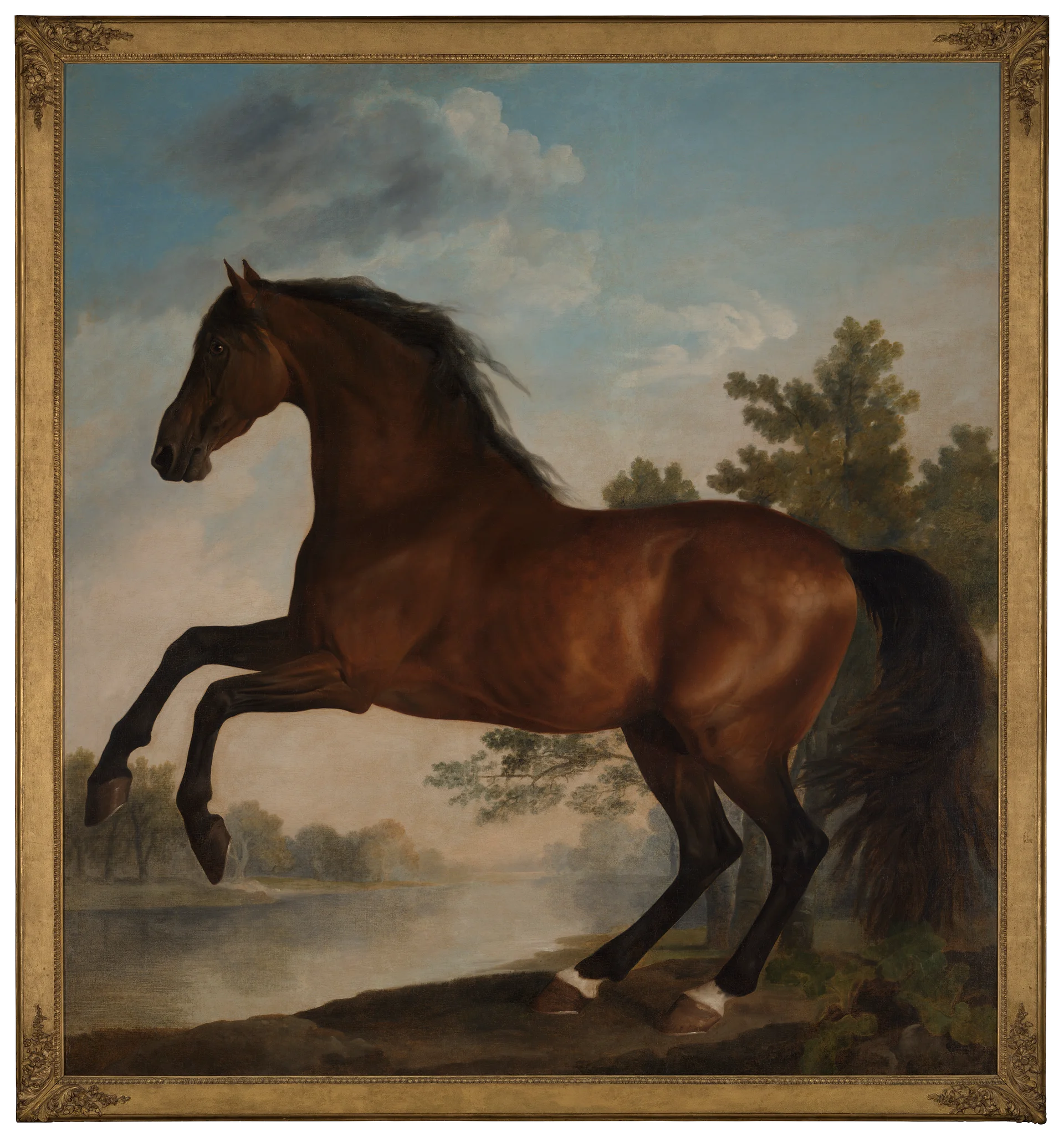
Oil on canvas, 268 x 244.5 cm
© Private Collection. Photo: The National Gallery, London